Ais Kacang x IDD 2018
Ais Kacang x IDD 2018 is a collaboration project between final year BGDSHU and BIDSHU students. The aim is to present a Malaysian dish, Ais Kacang, and visualize it for a far future. Our group consists of 7 students, 2 from BGDSHU and 5 from BIDSHU. We decided to tackle on overpopulation and how it contributes to pollution. But first, take a look at the team :
After forming our group, we began brainstorming on ideas on how to have a presentable Ais Kacang. We had so many meetings, that it is hard to count the number of times. But our meetings are never dull, cause we always crack jokes and laugh at it for hours. Just look at us here :
But anyway, during the discussion, while we ate our lunch, we started to think of how an Ais Kacang would look like in the future after overpopulation have taken over. Our vision of the situation is that resources would be limited and people would fight each other to obtain their needs. Blood will shed! So, once that discussion was done, we individually started sketching our own ideas to see which would suit the best. In the end, we decided to use back everyone’s sketch by merging it into one. Voila :
We then had our interim presentation to pitch our idea. We volunteered Emma to be our presenter as we felt she had extremely good presenting skills. This is our presentation slides :
After sketching, we started planning out our materials and where to get them. Everyone had to get different items. For me, it was acrylic, watercolour, brushes, Chinese ink, and a palette. We gathered together outside of the Mezzanine Floor on Thursday to start our masterpiece. Take a look at us here enjoying ourselves while making our Ais Kacang :
We really enjoyed ourselves while building the prototype. After building the prototype, Pavitra and I designed the presentation boards for our final presentation. Below are how our boards look like :
On presentation day, we asked Emma to present for us again, after her wonderful presentation during the interim. We brought in our prototype to show our lecturers the outcome of the project. This is us after our presentation with our Ais Kacang :
Click the button below to access the final presentation slides.
My Reflection :
-
I enjoyed my time in this group
-
We had good communication skills when speaking to one another
-
We support one another during the project and make sure each contributed something
-
Overall, it was a well accomplished project and I had lots of fun
Take a look at our exhibition space here :


Ais Kacang x IDD 2018
Ais Kacang x IDD 2018 is a collaboration project between final year BGDSHU and BIDSHU students. The aim is to present a Malaysian dish, Ais Kacang, and visualize it for a far future. Our group consists of 7 students, 2 from BGDSHU and 5 from BIDSHU. We decided to tackle on overpopulation and how it contributes to pollution. But first, take a look at the team :
After forming our group, we began brainstorming on ideas on how to have a presentable Ais Kacang. We had so many meetings, that it is hard to count the number of times. But our meetings are never dull, cause we always crack jokes and laugh at it for hours. Just look at us here :
But anyway, during the discussion, while we ate our lunch, we started to think of how an Ais Kacang would look like in the future after overpopulation have taken over. Our vision of the situation is that resources would be limited and people would fight each other to obtain their needs. Blood will shed! So, once that discussion was done, we individually started sketching our own ideas to see which would suit the best. In the end, we decided to use back everyone’s sketch by merging it into one. Voila :
We then had our interim presentation to pitch our idea. We volunteered Emma to be our presenter as we felt she had extremely good presenting skills. This is our presentation slides :
After sketching, we started planning out our materials and where to get them. Everyone had to get different items. For me, it was acrylic, watercolour, brushes, Chinese ink, and a palette. We gathered together outside of the Mezzanine Floor on Thursday to start our masterpiece. Take a look at us here enjoying ourselves while making our Ais Kacang :
We really enjoyed ourselves while building the prototype. After building the prototype, Pavitra and I designed the presentation boards for our final presentation. Below are how our boards look like :
On presentation day, we asked Emma to present for us again, after her wonderful presentation during the interim. We brought in our prototype to show our lecturers the outcome of the project. This is us after our presentation with our Ais Kacang :
Click the button below to access the final presentation slides.
My Reflection :
-
I enjoyed my time in this group
-
We had good communication skills when speaking to one another
-
We support one another during the project and make sure each contributed something
-
Overall, it was a well accomplished project and I had lots of fun
Take a look at our exhibition space here :


The Homeless Series
The Homeless Series is a project to raise awareness on showing kindness to the homeless.
My research:
Do the homeless have a purpose in life? Do they contribute to the society, or are they just a waste of space? The intention of this project is to raise awareness on treating the homeless with kindness by using rats as a catalyst.
Homeless are individuals that lacks a place to live. They do not have a permanent living accommodation and are sometimes part of a transitional housing system and may be living on streets, single room occupancy facilities, abandoned buildings, vehicles, parks, bus or train stations, and other non-non-permanent situations. Some may even be forced to room-in with their friends or family members due to not having a fixed residence. The homeless, besides a place to stay, cannot afford other living amenities such as food, water, and clothing. They are sometimes forced to beg on the streets just to afford these living amenities, or find soup kitchens as another option. The homeless are also not treated kindly by the other norms of life, with most believing the homeless do not fit their style of living. However, not all the homeless are deep in poverty as some do have daily jobs that they attend to. These homeless just do not make enough for a proper living, with nothing to spare for a proper home and as a result, forced to stay on streets and parks with limited living facilities. The homeless is a serious problem faced globally and many turn a blind eye to it.
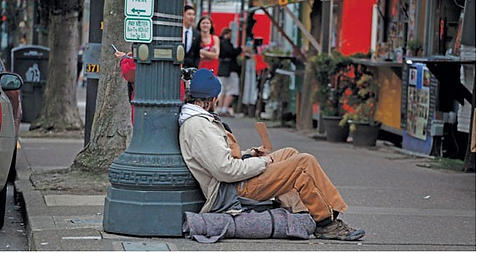
In Malaysia, the homeless is a serious problem, especially at the heart of Malaysia: Kuala Lumpur. Eyeing Kuala Lumpur, one would immediately assume that the city is successful with fancy expensive cars, tall luxury buildings, and glamorous malls with branded items. However, the city has a hidden dark side beneath all the luxury: poverty. Along the luxury and glamorous streets of Kuala Lumpur, the city’s homeless can be seen loitering around. While the city buzzes with energy and excitement with the existence of cafes, bars, and nightclubs, it is usually after 3am where most of the homeless can be seen along the streets, sleeping on cardboard boxes as mattresses on hard cold floors. In deep of poverty, the homeless have no choice but to sought help from soup kitchens. Soup kitchens are places that offers free hot meals to the homeless, and also contributes in helping the homeless with basic necessities such as clothing, non-perishable food items, and even health services. The harsh truth about the homeless? Most of them actually have a life of their own, having a job, just like the rest of us adults, have an education, and even had led a normal life once. However, they do not make enough income to buy or rent a place. The difficulty of life cost them: becoming homeless.
This is why Gary Liew started Street Feeders of KL, a non-governmental organisation, with a group of friends in 2011. As a child, Liew used to help his mother cook lunch for the homeless at a soup kitchen at St. John’s Cathedral in Kuala Lumpur, established by Carl D’Cunha, from Mondays to Fridays. Both his mother and D’Cunha often taught Liew the importance of being friends with the homeless, and that the quality of the food should never be compromised just because the homeless are less fortunate than the rest of the people. According to D’Cunha, the homeless “are not only poor of money, but most of all they are poor of love, companionship, and people who truly care for their well-being.” The homeless lacks compassion and kindness from the public, also known as Malaysians. Running the soup kitchen, Gary Liew does not only focus on feeding the homeless, he also forms a connection with them and tries to get them back on their feet. To Gary Liew, he sees the homeless as equal human beings, with the only difference is that they are the less fortunate. Whenever he is around the soup kitchen, he would try to strike conversations with the homeless and try to form a friendship with them in order to zoom more focus into helping the homeless “re-integrate into the society through counselling and potential job opportunities.” The overall goal of this is to show some respect, dignity, and hope towards the homeless through assistance in order to step out of poverty.
Most Malaysians, through research and observation, do not treat the homeless with much respect, let alone with kindness. They would prefer to be far away from the homeless rather than to breath the same air with the homeless. As the homeless has no home to go back too, they are forced to live on the streets and along the roadsides. These locations are the hot spots where Malaysians would end up bumping into the homeless. As such, Malaysians would tend to act rough towards the homeless, and not wanting to show any form of kindness towards the homeless. Due to such situations, the homeless are led to believe that they do not belong to the society and community, believing that they are just a waste of space. However, do the homeless and rats share a similar situation here in Malaysia? While the homeless are treated with unequal love by most people, do rats suffer the same fate?
Rats are one of the most common rodents known in almost all parts of the globe, existing for around millions of years. As medium-sized rodents, they are known to be able to adapt to their environment at a fast rate, except extreme areas such as Antartica. While their origin is not known, many theories indicates that they originally were from Asia and found their way to the European and Western hemisphere through cargo and ships. Rats are able to live in a variety of places such as the wildlife and neighbourhood surrounding such as buildings and homes while some species of rats, such as the wild tree rats, can live on tropical islands. These rats are capable in adapting to nearly any kind of condition. They can survive in lighted areas, dim areas, in warm and moderate temperatures, and cold-winter areas. As long as there is access to food, any condition is suitable for rats. Living in these conditions, rats are able to communicate emotions through squeaking, besides providing warnings to other rats.
Most rats are characterised as shy but clever rodents that wishes to not be seen nor disturbed. When rats are in the presence of humans, they would find any place to hide themselves. They mostly prefer to be left alone, despite the need to adapt to living with humans, and will come out from hiding if they are disturbed. They would also be forced to bite a human if they believe that they are in-danger. The eating habits of rats varies between the type of breeds. Some rats prefer sweet things and proteins, grains, and some would eat fruits and vegetables such as tomatoes, and melons. There are also rats that eats meat and fish. Rats are considered as opportunistic eaters due to being able to eat just about anything that they can chew or bite. Rats are mostly active at night as they are able to avoid human contact, and would get food from dumpsters and among leftover garbage.
RWhile it looks like rats are useless rodents, they do have a job of their own. Among them are they serve as scavengers and opportunistic eaters, eating away trash and disposals thrown away by humans. They are also an important element in the animal ecosystem. The animal ecosystem is a balance of nature, and without rats, the system can fall, as rats serves as food for predatory animals such as falcons, owls, hawks, and snakes. Rats have a good ability in tracking and are fast learners. In so, they are used in scavenging old war land mines. Undetonated land mines causes unnecessary deaths each year, besides leaving geographical area uninhabitable. Therefore, rats, specifically African giant pouched rats, are used to sniff out the explosives buried in the ground. They are trained by the Anti-Personnel Landmines Detection Product Development (APOPO) to naturally track down the explosives, and the training is easy for them due to being fast learners. These rats are also trained to locate people in-need during natural disasters, and in detecting leakage among gas lines. According to Mueller, rats “play a key role in spurring growth of new trees in the forest by spreading seeds.” The Kivu giant pouched rat, an African rodent, is responsible in the dispersant of seeds for the plant growth, scattering and hoarding the larger seeds over the ground. These rats also would build caches of seeds for consumption. The germination of the seeds would turn in into a new vegetation. Similar to the Kivu, the Kangaroo Rats also has a similar behaviour, and the seeds that sprouts from the ground, along with other organic matter, becomes food for the rodents for winter.
However, most humans barely acknowledge the importance of rats. One of the reasons for the conflict between humans and rats is rats are viewed as dangerous by humans. Rats are know to bite, which may contain bacteria that are harmful to humans and can cause rat-bite fever. A rats urine can cause Hantavirus, a very dangerous disease, which can also be transmitted through a rats bite. Food poisoning can also be inflicted when rats wander around kitchens and areas with the presence of food. Rats find it satisfying being in the presence of garbage, which leads to food contamination. Rats, just like the homeless, are mostly faced with negative reactions from the people. Therefore, rats are used as a catalyst for the homeless in hopes of raising realisation of the state of life the homeless are faced with among Malaysians. One way for realisation is using storytelling to let the people learn the harsh truth of the homeless.
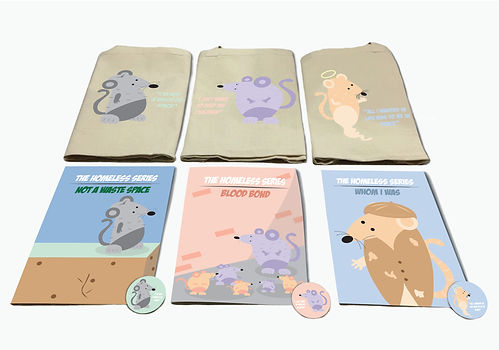
Therefore, an understanding of what the project intention was going to be had to be done. The main objective of this proposed project is to raise awareness on what Malaysians currently do towards the homeless and what a simple act of kindness could impact the future of the homeless people. The direction of the project is to raise the importance of kindness between the privileged Malaysians and the homeless. While it is not necessarily a campaign, the outcome was to slightly mirror a campaign, with the creation of badges, posters, tote bags, along with the main object: comical books. The style used in all the digital works is towards illustrations and vector art. Initially, it was intended to use a “messy” concept towards the projects. The “messy” concept is an intended style in which one would get dirty by doing hands on work while also multitasking with digital works. It is a combination of both traditional and modern graphic design. However, somewhere along the line, the intention gradually shifted for the best.
Take a look at the proposal here:
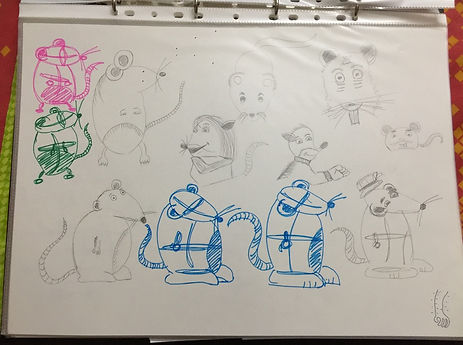
With references, I started to randomly sketch some rats as a form of representation of the homeless of different variations to kick start the project. See below some of my sketches:
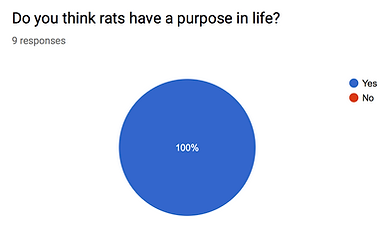
Once I did a few sketches, I went for tutorial with Mr Sean to find out how to develop my process. We talked, and I told him about my plan to do an awareness campaign about the homeless by using rats as a representation. I told him about my plan to do comical books as my target audience are teenagers and young adults. I also talked to him about a survey I did about rats before I had the idea to do about the homeless.
From here on, I decided to change the topic to homeless and relate it to rats. So I continued to sketch more before I start drafting the comical books.
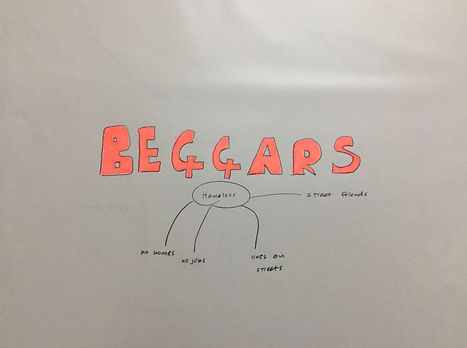
While doing sketches, I also did some mind maps about the homeless to fully dive into it.
From than on, I started to sketch out layouts for the comical book and drafted the storyboard for each story.
I wanted each story to have the opposite of kindness: cruelty, to show the impact towards the homeless when we choose to not show compassion, love, and kindness to them.
While doing the storyboard, I also decided to create button badges and tote bags as promotional materials to support the comical books.
The tote bag can be used by many people and it is a free advertising for the comical books as the tote bags will be brought around and can spark conversations between the people. The same goes for the button badges. I also created supporting posters to support the final outcome.
And…… we are done! Take a look at my presentation board here: